


 Free Newsletter

NY appeals court prohibits second trial in Rochester murder case
Bennett Loudon//March 18, 2024//


 Listen to this article
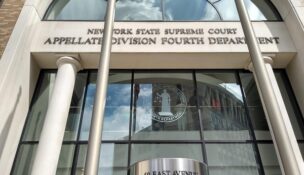
A state appellate court has granted a petition to prohibit the Monroe County District Attorney’s Office from retrying a defendant in a murder case in which the judge declared a mistrial.
Defendant Willie Shipmon and co-defendant Troy Jones were charged with second-degree murder and two counts of criminal possession of a weapon in connection with the June 17, 2021, shooting death of Brandon McClary in Rochester.
Shipmon was represented at the trial in September by attorneys Robert A. Napier and Lindsey M. Pieper.
In the middle of the second day of jury deliberations, after the alternate jurors had been dismissed, state Supreme Court Justice Thomas E. Moran received a note from the jury asking: “If we have a decision on five counts but not on one of them, what would our course of action be?”
Moran told the jurors that it was too early to “contemplate a partial verdict” and instructed them to continue deliberating, according to the Fourth Department‘s decision.
After an exchange of more notes, the foreperson informed Moran that one juror refused to continue deliberating further and wanted to “get back” to the case after the weekend, according to the decision.
Moran sent the jury home, and, over the weekend, received two messages directly from jurors. The first message claimed that a juror — later identified as juror No. 5 — had conducted independent research into the definition of second-degree murder and had discussions about the case outside the presence of the full jury, according to the decision.
In the second message, juror No. 5 requested to speak Moran.
When court reconvened, Morna and the attorneys questioned juror No. 5, who denied conducting independent research or discussing the case outside the presence of the full jury.
He claimed there had been “tension in the jury room” caused by jurors making comments “having racial connotations,” according to the decision.
“He further stated that, although he felt pressured by the other jurors, he believed that a resolution was still possible,” according to the decision.
Moran questioned each juror, asking whether they were aware of any juror researching the definition of second-degree murder, discussing the case outside the presence of the full jury, or making racial comments.
Three jurors said that juror No. 5 told them that he looked up the definition and he tried to engage in deliberations outside the presence of the full jury.
Several jurors also said there had been some racial tension during deliberations and noted that juror No. 5 was the only Black man on the jury.
None of the jurors stated that juror No. 5 had shared his findings about the definition of second-degree murder, and the jurors’ descriptions of discussions outside the presence of the full panel suggested the incidents were “brief and not substantive,” according to the decision.
Moran did not permit Shipmon’s attorneys to ask any questions about whether a partial verdict had been reached and, if so, whether the racial tensions started before or after that point.
Moran “expressed frustration that his admonishments to the jury had been violated and asked the parties whether they were moving for a mistrial,” according to the decision.
Jones’s attorney made a motion for a mistrial, but Napier and Pieper did not. They requested that deliberations continue with 11 jurors, but Moran declared a mistrial.
Shipmon’s attorneys requested that the jury be polled to determine whether they had reached a partial verdict. Moran denied that request.
Shipmon was represented in the appeal by Pieper, who argued that a new trial should be prohibited on double jeopardy grounds.
“The People have not met their burden of demonstrating that the declaration of a mistrial was manifestly necessary. Assuming … that juror No. 5 was grossly unqualified to continue serving, we conclude that the court abused its discretion in declaring a mistrial without considering other alternatives,” the Fourth Department wrote.
“Petitioner expressed his desire to waive trial by a jury of 12 individuals and proceed with the remaining 11 jurors, an option that has been endorsed by the Court of Appeals,” the court noted.
The Fourth Department wrote that “it would have been appropriate to poll the remainder of the jurors to ascertain whether they could render an impartial verdict.”
“It was an abuse of discretion to have declared a mistrial on all of the counts in the indictment without inquiring whether a decision had been reached on any of the charges,” the court wrote.
“Although there was not ‘overwhelming evidence’ that a partial verdict had been reached … the jury’s note asking for guidance on next steps … presented more than a mere inference that the jury may have reached a partial verdict,” the Fourth Department wrote.
“Under these circumstances, the court was required to make an inquiry “as to whether a verdict had been reached on any of the counts … before declaring a mistrial over the petitioner’s objection.”
Moran “failed to obtain enough information whether a mistrial was actually necessary as to all counts. Thus, a retrial is precluded,” the court wrote.
“I think it will become a very important case on interpreting the double jeopardy clause with respect to the absolute necessity that the trial court have no other recourse but to declare a mistrial,” Napier said.
The Monroe County District Attorney’s Office issued the following statement: “While we respect the decision from the appellate court, it is unfortunate that we will not have an opportunity to once again try this case based on its merits.”
“We are disappointed with this ruling because the circumstances that led to this decision were outside of our control. It is disheartening for the District Attorney’s Office, the family of the victim, and the entire community, that the end result of this decision is that Mr. Shipmon will not face these allegations in a court of law.”
Doorley has not yet decided whether to appeal the decision to the New York State Court of Appeals.
[email protected] / (585) 232-2035
Related Articles
Related Content




Case Digests
- Fourth Department – Ineffective assistance of counsel: People v. Thanthima
- Second Circuit – Sentencing: United States v. Dralle
- Fourth Department – Ineffective assistance of counsel: People v. Serrano
- Second Circuit – Habeas Corpus: Brown v. James
- Fourth Department – Comptroller authority: Scanlon v. Miller-Williams
- Fourth Department – Confidential witness: People v. Sanchez
- Second Circuit – Interest-on-escrow accounts: Cantero v. Bank of America, N.A.; Hymes v. Bank of America, N.A.
- Fourth Department – Relation back doctrine: Poindexter v. The State of New York
- Fourth Department – Double jeopardy: People v. Royal
- Fourth Department – Real property claims — Summary judgment Penn v. Rochester Rev Holdings, LLC
- Second Circuit – Breach of lease agreement: Delsha 60 Ninth, LLC v. Free People of PA LLC


Law News
- Driver who caused fatal MVA sued by victim’s mother
- NY Court of Appeals resolves Appellate Division inconsistency
- Oneida County attorney disbarred after Trump pardon
- New trial ordered in child sex abuse case
- Rochester, Monroe County to pay $1.75M to officer blinded in stabbing
- Drug conviction reversed over faulty indictment
- Phillips Lytle names new Rochester office leader
- WNY nursing home fraud settlement could total $9M
Polls
 Loading ...