


 Free Newsletter

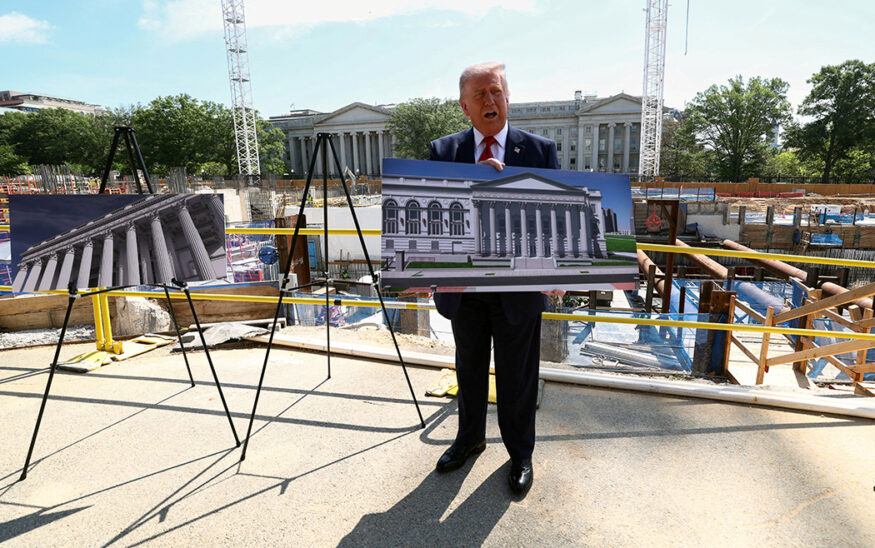
FILE PHOTO: U..S. President Donald Trump speaks at the site of ongoing construction of the planned White House ballroom in Washington, D.C., U.S., May 19, 2026. REUTERS/Kevin Lamarque/File Photo
US appeals court hears challenge to Trump’s White House ballroom
Reuters Connect//June 5, 2026//


 Listen to this article
WASHINGTON (Reuters) – U.S. President Donald Trump’s administration asked an appeals court on Friday to allow construction of a $400 million ballroom on the site of the White House’s demolished East Wing, pitting Trump against preservationists in a case testing the limits of presidential authority.
A lawyer for the administration, Yaakov Roth, told a three-judge panel of the U.S. Court of Appeals for the District of Columbia Circuit that the challengers seeking to block the project do not have legal standing to pursue their lawsuit.
“It’s an architectural preference on one hand and the safety and security of the President of the United States on the other hand,” Roth said. “We have evidence here that the old East Wing was not adequate to protect the safety and security of the President and others in the White House leadership of the executive branch.”
Judge Patricia Millett suggested the government’s argument amounted to “move fast and break things and nobody has standing.”
The National Trust for Historic Preservation, a nonprofit group that campaigns to protect significant American sites, sued last year after the Trump administration tore down the East Wing in October 2025 and began building a 90,000-square-foot (8,360-square-meter) ballroom without seeking authorization from Congress.
U.S. District Judge Richard Leon, appointed by Republican former President George W. Bush, twice blocked above-ground construction on Trump’s ballroom while allowing underground work to continue.
Leon said no federal statute even “comes close to giving the President” the required authority to construct the ballroom without approval by Congress.
The administration’s appeal is being heard by Democratic-appointed D.C. Circuit judges Millett and Bradley Garcia alongside Trump-appointed Judge Neomi Rao. In an order last month, the appeals court allowed construction to continue during the legal battle without ruling on the merits of the case.
The panel could issue a more significant ruling in the next few weeks, which could be appealed to the U.S. Supreme Court.
Related Content





Case Digests
- Second Circuit – Appellate counsel: United States v. Samuels
- Fourth Department – Pre-answer motion to dismiss: Villalba v. City of Auburn, et al.
- Court of Appeals – Office of Children and Family Services: Lawyers for Children, et al. v. NYS Office of Children and Family Services, et a.
- Fourth Department – Assault: People v. Talley
- Court of Appeals – Family Court Act: Abdoch v. Abdoch
- Second Circuit – Medicaid: Bellin v. McDonald
- Fourth Department – Family Court: Sprague v. Younes
- Second Circuit – False Claims Act: United States of America v. Amazon.com Inc.
- Fourth Department – Notice of claim: Jarrod W.S. v. Jordan-Elbridge CSD, et al.
- Western District Case Notes
- Second Circuit – Distribution of a controlled substance: United States v. Parasmo


Law News
- Convictions reversed over illegal police search
- NY judge rejects motion to collect on Iowa court judgment
- Bronx prosecutor misses filing deadline by 12 seconds
- Second-degree murder count reversed, leaving first-degree conviction
- Court of Appeals ends foster care program
- Experts highlight tax and regulatory changes
- NY appeals court reinstates robbery indictment
- Court of Appeals affirms convictions despite tainted transcript
Polls
 Loading ...