


 Free Newsletter

Split court allows lawsuit over workplace accident to proceed
'There are triable issues of fact'
Bennett Loudon//August 11, 2023//
Split court allows lawsuit over workplace accident to proceed
'There are triable issues of fact'
Bennett Loudon//August 11, 2023//


 Listen to this article
In a split decision, a state appeals court has allowed a lawsuit over a workplace accident to proceed.
Plaintiff Paul Scime filed the lawsuit seeking damages for injuries that he allegedly suffered when he was hit by a vehicle operated by defendant Daniel Boyd and owned by Hale Northeastern Inc.
Boyd was backing the vehicle out of a loading dock and hit Scime, who was either standing or walking in the area behind the vehicle while talking on his cell phone and smoking a cigarette.
Although Scime continued talking on the phone and smoking the cigarette after the collision, he later filed the lawsuit alleging that he suffered a serious injury within the meaning of Insurance Law.
After the discovery portion of the case, Scime filed a motion for partial summary judgment on the issues of “liability and sole proximate cause and . . . serious injury,” and for dismissal of seven affirmative defenses.
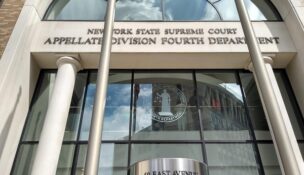
In July 2022, state Supreme Court Justice Mark A. Montour denied the motion. In a recent 3-2 decision, the Appellate Division of state Supreme Court, Fourth Department, affirmed Montour’s ruling, which granted part of the motion by dismissing five affirmative defenses but otherwise denied the rest of the motion.
“We initially conclude that the court properly denied that part of plaintiff’s motion seeking summary judgment on the issue of negligence inasmuch as there are triable issues of fact whether Boyd was negligent in his operation of the vehicle,” the majority wrote.
In his deposition, Boyd testified that, before moving the vehicle in reverse, he looked in his rear-view mirrors and did not see anyone behind the vehicle. After driving the vehicle in reverse for about five to 10 feet, Boyd heard a thud and then stopped the vehicle and discovered that he had struck Scime.
In his deposition, Scime testified that, although he believed that he was stationary at the time of impact, he could not recall whether he was stationary or pacing as he smoked his cigarette and talked on the phone.
Scime also testified that he did not see the vehicle driven by Boyd until it hit him.
“Boyd’s testimony, if believed by the trier of fact, would support a finding that plaintiff was not stationary behind the vehicle and instead walked into the vehicle’s path unexpectedly, and that Boyd was therefore not negligent,” the majority wrote.
“Under the circumstances, plaintiff’s own submissions raised an issue of fact on the issue of negligence. Contrary to plaintiff’s further contention, we conclude that the court properly denied his motion with respect to the issues of proximate cause and serious injury,” the majority wrote.
Because Scime could not recall whether he was stationary or pacing, “his own submissions raise triable issues of fact whether he was comparatively negligent in potentially walking directly into the path of a reversing vehicle,” according to the decision.
Scime initially alleged that he suffered injuries to his left shoulder and cervical spine, but on appeal he only claims injuries to his left shoulder.
Scime submitted medical records and expert testimony that the accident caused the injuries to his shoulder and that those injuries constituted serious injuries.
Scime also submitted the opinion of a doctor who said that, in the months immediately following the accident, Scime had full range of motion in his left shoulder, “but with pain on extremes,” the court wrote.
Scime also submitted the report of a doctor who gave the opinion that “any injury plaintiff may have sustained to his left shoulder as a result of the accident did not constitute a serious injury.”
“We conclude that the conflicting medical opinions submitted by plaintiff mandated denial of plaintiff’s motion because they raised a question of fact whether he sustained a serious injury that was caused by the accident,” according to the decision.
Justices Tracey A. Bannister and E. Jeannette Ogden dissented.
“We respectfully dissent inasmuch as we conclude that Supreme Court erred in denying that part of plaintiff’s motion seeking summary judgment on the issue of negligence, and we would therefore modify the order accordingly,” they wrote,
“Plaintiff met his initial burden on the motion by establishing as a matter of law that defendant Daniel Boyd was negligent in … backing the vehicle into plaintiff without properly looking behind him,” they wrote.
According to his deposition testimony, when Boyd was getting into his vehicle, he observed people smoking in the area behind his vehicle.
“He testified that, prior to backing up the vehicle, he turned his head to look out of the left side mirror of the vehicle and that, although he ‘peeked’ or took a ‘very quick glance’ in his rearview mirror, he focused his attention on the left side mirror,” the minority wrote.
“We conclude that plaintiff established as a matter of law that Boyd was negligent in failing to see that which, under the circumstances, he should have seen and in backing the vehicle up before ascertaining that it was safe to do so. Further, in our view, defendants failed to raise an issue of fact,” Bannister and Ogden wrote.
“We disagree with the majority that there is an issue of fact concerning plaintiff’s comparative fault that precludes summary judgment on the issue of negligence,’ they wrote.
Scime was not required to anticipate that Boyd would back his vehicle toward him, they wrote.
“It was Boyd’s obligation in the first place to ensure it was safe to back up his vehicle. We otherwise agree with the majority’s determination that questions of fact exist with respect to causation and whether plaintiff sustained a serious injury within the meaning of Insurance Law,” the minority wrote.
[email protected] / (585) 232-2035
Related Content





Case Digests
- Fourth Department – Substitution of counsel: People v. Bredt
- Fourth Department – Statute of limitations: Broton v. County of Onondaga
- Fourth Department – Suppression: People v. Ayer
- Fourth Department – Breach of contract: Amber Well Drilling v. Reed , et al.
- Fourth Department – Murder: People v. Baxter
- Fourth Department – Judgment lien: Anthone v. Carlo
- Fourth Department – Video evidence: People v. Alexander
- Court of Appeals- Copyright infringement: Richardson v. Townsquare Media Inc.
- Fourth Department – Marital property: Zatyko v. Zatyko
- Second Circuit – Supervised release: United States v. Brown
- Fourth Department – Exculpatory evidence: People v. Williams


Law News
- Judge suppresses evidence in drug case, cites ‘troubling aspect of police behavior’
- NY appeals court rules EMT is not entitled to jury trial on misconduct complaint
- Law Day – Celebrate judicial independence
- NY appeals court reinstates medical malpractice lawsuit
- Lender files foreclosure action on Rochester Airport Marriott
- ERPO issued against former prison guard connected to inmate death
- NY appeals court vacates convictions over illegal frisk
- The Goldberg Segalla law firm celebrates 25th anniversary
Polls
 Loading ...