


 Free Newsletter

Appeals court: Father’s consent not required for adoption
Bennett Loudon//December 23, 2025//


 Listen to this article
Key takeaways:
- Fourth Department affirmed Family Court ruling dispensing with father’s consent.
- Court found clear and convincing evidence of child abandonment.
- Incarceration did not excuse lack of contact or support.
- Stepfather, married to child’s mother, completed the adoption.
A state appeals court has ruled that the consent of a father is not required for his child to be adopted.
In July 2024, Yates County Family Court Judge Patrick F. McAllister ruled that the biological father’s consent was not required for the adoption because he had essentially abandoned the child.
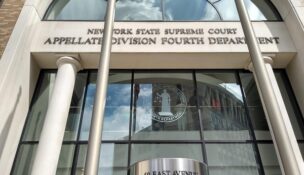
The biological father appealed, and the Appellate Division of state Supreme Court, Fourth Department, affirmed McAllister’s ruling.
The child was adopted by a man who is married to the child’s mother and has acted as the child’s stepfather since she was approximately 18 months old.
“Where, as here, a child is conceived or born in wedlock, a parent’s consent to adoption is required unless the parent evinces an intent to forego their parental or custodial rights and obligations as manifested by their failure for a period of six months to visit the child and communicate with the child or person having legal custody of the child, although able to do so,” according to the Fourth Department decision.
“When a parent’s inability to visit with the child results from their own deliberate acts, such as criminal conduct, the underlying circumstances need not preclude a finding of a lack of contact with the child evincing an intent to abandon the child,” the court wrote.
“The fact that a parent is incarcerated does not in itself excuse their failure to support, maintain contact with, or plan for the future of the child,’ the panel wrote.
“Where the person having custody of the child thwarts or interferes with the noncustodial parent’s efforts to visit or communicate with the child, a finding of abandonment is inappropriate,” the court wrote.
The party seeking a finding of abandonment “has the burden of establishing abandonment by clear and convincing evidence,” according to the decision.
“We conclude that Family Court properly dispensed with respondent’s consent to the adoption of the child inasmuch as petitioner established by clear and convincing evidence that respondent abandoned the child,” the court wrote.
McCallister considered the biological father’s contact with the child during the period of time immediately preceding the filing of the petition.
Contrary to the father’s contention, even though he was incarcerated for a part of that period, “that does not in itself excuse his failure to maintain contact with the child,” the court wrote.
“The evidence presented at the hearing established that (the biological father) sent the child a single letter during his period of incarceration of approximately 2½ years, which constitutes insubstantial and infrequent contact that is insufficient to preclude a finding of abandonment,” the court ruled.
“The court was entitled to reject respondent’s testimony that he was logistically and financially unable to contact the child more during his incarceration, particularly considering the evidence that he had the means to contact other people from prison, such as his sister,” the panel wrote.
The court also noted that contrary to the contention that he could not contact the child following his release from prison due to the conditions of his parole “falls short of adequately explaining his failure to meet his parental obligations inasmuch as there is no indication that he was precluded from contacting the mother, which he failed to do.”
“We conclude that the court properly determined that the record does not support the conclusion that petitioner or the mother thwarted or interfered with respondent’s efforts to communicate with the child,” the court wrote.
[email protected] / (585) 232-2035
Related Articles
Related Articles
Related Content





Case Digests
- Fourth Department – Probation conditions violations: People v. Relyea
- Fourth Department – Ineffective assistance of counsel: People v. Remington
- Court of Appeals – Substitution of counsel: People v. Kelley
- Fourth Department – Due process: People v. Pulley
- Court of Appeals – Equitable estoppel: Incorporated Village of Freeport v. Freeport Plaza West LLC
- Court of Appeals – Ineffective assistance of counsel: People v. Guerra
- Second Circuit – Death results clause: United States v. Parks
- Fourth Department – Suppression: People v. Post
- Court of Appeals – Mandated judicial retirement: Miller, et al. v. State of New York, et al.
- Fourth Department – Judicial misconduct: Pitts-Davis v. The Onondaga County DA
- Second Circuit – Property demolition: Levin, Vodka Properties LLC v. City of Buffalo


Law News
- Cybersecurity requires strategy, culture and vigilance, local experts advise
- Gun conviction reversed over illegal search
- NY appeals court grants new trial for defendant who attacked RPD officer
- NY appeals court reinstates attempted murder charge
- Harris Beach Murtha adds Boston firm Peabody & Arnold
- Attorney and law firm sanctioned for AI mistakes in court filing
- New rule requires NY judges to visit detention sites
- Split NY Court of Appeals affirms assault conviction
Polls
 Loading ...