


 Free Newsletter

NY appeals court grants new trial over denied pro se request
Bennett Loudon//April 29, 2025//


 Listen to this article
A state appeals court has reversed a weapon conviction and granted a new trial because the judge ignored the defendant’s request to represent himself.
Defendant Stephen Taylor was convicted after a bench trial before state Supreme Court Justice Thomas E. Moran in May 2022 of second-degree criminal possession of a weapon, and seventh-degree criminal possession of a controlled substance.
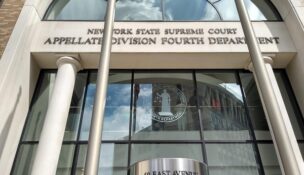
In a decision released Friday, the Appellate Division of state Supreme Court, Fourth Department, unanimously reversed the verdict and granted a new trial.
Taylor’s appellate attorney, Stephanie M. Stare, argued that the convictions should be reversed because Moran summarily denied Taylor’s request to proceed pro se.
The Fourth Department agreed.
The court wrote that a defendant in a criminal case may invoke the right to proceed pro se if: the request is unequivocal and timely asserted; there has been a knowing and intelligent waiver of the right to counsel; and the defendant has not engaged in conduct which would prevent the fair and orderly exposition of the issues.
Talor requested to represent himself before the start of trial, stating: “I would like to go pro se, and I would like to bring something to the (court’s) attention if I may, your honor.”
Moran initially ignored the request, but Taylor’s trial attorney raised the issue twice more and Moran told Taylor: “We are not going to address the issue of pro se.”
Moran told Taylor the attorney was “one of the most experienced defense attorneys in town.”
“Given that the court recognized defendant as having unequivocally requested to proceed pro se, it was then required to conduct a ‘searching inquiry’ to ensure that … defendant’s waiver (of the right to counsel was) knowing, intelligent, and voluntary,” the Fourth Department wrote.
“Because the court erred in summarily denying the request without conducting the requisite inquiry, we reverse the judgment and grant a new trial,” the court ruled.
The court rejected several other arguments made by Stare.
She claimed that Moran should not have issued a protective order that allowed the prosecutor to withhold from the defense, until 10 days before trial, the identity of a confidential informant.
“We reject that contention,” the Fourth Department wrote.
The court may issue a protective order for “good cause,” which includes “danger to . . . the safety of a witness” or “risk of intimidation,” the Fourth Department wrote.
The prosecutor submitted an ex parte motion that provided “a sufficiently detailed factual predicate to enable the court to evaluate the applicability of the statutory factors governing the issuance of protective orders, assess the weight to be given to each factor, and draw an appropriate balance,” the panel wrote.
“Based on that factual predicate, the court determined that there was good cause for a protective order, and we see no reason to disturb the court’s exercise of discretion,” the court wrote.
Stare also claimed Moran should have suppressed physical evidence because the police relied on the confidential informant to obtain the evidence.
“We reject that contention. We have reviewed the sealed transcript of the Darden hearing, as well as the court’s requisite summary report as to the existence of the informer and with respect to the communications made by the informer to the police to which the police testify,” the court wrote.
“Based on those documents, we conclude that the court properly determined that the confidential informant existed and that he provided the information to the police concerning defendant’s possession of the handgun at the location where defendant was stopped by the police and subsequently arrested,” the court wrote.
A contention that the court erred in failing to reopen the suppression hearing was not preserved for appellate review and the court declined to exercise its power to review that contention as a matter of discretion in the interest of justice.
[email protected] / (585) 232-2035
Related Articles
Related Articles
Related Content





Case Digests
- Fourth Department – Extreme Risk Protection Act: NYS Police v. Galliher
- Fourth Department – Division of Human Rights: NYS Assembly v. NYS Div. of Human Rights, et al.
- Court of Appeals – Domestic Violence Survivors Justice Act: People v. N.H.
- Second Circuit – Class action: In Re: Payment Card Interchange Fee and Merchant Discount Antitrust Litigation
- Fourth Department – Surrogate Court appointments: Mosey v. Office of Court Administration
- Fourth Department – Suppression of physical evidence: People v. Moore
- Court of Appeals – Criminal possession of a weapon: People v. Burgess
- Second Circuit – Conflict of laws: Maritime Law Matter of the Complaint of Verplanck Fire District
- Fourth Department – Long-arm jurisdiction: McInnis v. A.O. Smith Water Products, et al.
- Fourth Department – Right to counsel: People v. Maull
- Court of Appeals – Vehicle stop: People v. Ehinmiakhena


Law News
- WNY nursing home fraud settlement could total $9M
- Elmira settles federal lawsuit over police encounter for $2.5M
- Lawsuit claims Chili man was cheated out of home equity
- Appeals court affirms custody issue, but reverses $18,000 sanction
- NY appeals court reverses child custody decision, remits case to Family Court
- Donald Chesworth retires after distinguished legal career
- Lawsuit accuses Rochester police of property damage during search
- Five attorneys honored by Monroe County Bar Association
Polls
 Loading ...