


 Free Newsletter

NY appeals court questions discovery in attempted murder case
Bennett Loudon//July 10, 2025//


 Listen to this article
Key Takeaways:
- Defendant was convicted of attempted murder in Onondaga County.
- Appeals court found discovery compliance questions remain unresolved.
- Issue centers on police disciplinary records and speedy trial rights.
- Case sent back to County Court for further proceedings on dismissal.
A state appeals court has sent an attempted murder case back to the trial judge to decide if the prosecution complied with discovery requirements.
Defendant Vaughn Sanders was convicted before Onondaga County Court Judge Thomas J. Miller in December 2021 of attempted second-degree murder, second-degree criminal possession of a weapon, and tampering with physical evidence.
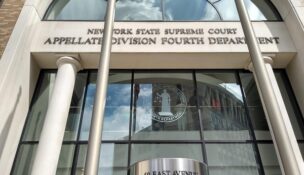
The Appellate Division of state Supreme Court, Fourth Department, has reserved decision and sent the case back to County Court for further proceedings.
The convictions stem from Sanders’ involvement in a shootout in Syracuse where a codefendant fired 12 shots at a police officer, intending to kill the officer.
The codefendant who fired at the police officer, and another codefendant, pleaded guilty. But Sanders rejected plea offers and went to trial. He was convicted of all charges.
Sanders appealed, claiming that Miller should not have allowed a police detective to give his opinion at trial that Sanders was the person in two surveillance videos.
Sanders claimed the detective was no more qualified than the jurors to determine whether he was the person in the videos.
But Sanders’ trial attorney failed to object to the detective’s opinion testimony. He only asked Miller for a limiting instruction to the jury, which Miller granted.
Because Sanders requested no further relief after the limiting instructions were read to the jury, the issue was not preserved for appellate review, “and we decline to exercise our power to address that contention as a matter of discretion in the interest of justice,” the court wrote.
The Fourth Department ruled that the prosecution was not required to provide notice of the identification testimony because the detective did not identify Sanders in a pretrial identification procedure.
Criminal Procedure Law Section 710.30 applies to “in-court identifications predicated on earlier police-arranged confrontations between a defendant and an eyewitness, typically involving the use of lineups, showups, or photographs, to establish the identity of the suspect, none of which happened in this case,” the court wrote.
Sanders’ appellate attorney, Casey S. Duffy, also argued that Miller should have dismissed the indictment on speedy trial grounds because the prosecution failed to disclose police disciplinary records as required.
Duffy claimed that reversal is required because the prosecution used a screening panel of senior prosecutors to determine which police disciplinary records were related to the subject matter of the case, and therefore subject to discovery as impeachment material, and which police disciplinary matters did not relate to the subject matter of the case, and thus not subject to automatic discovery.
“Although the People’s use of a screening panel in this case is not permitted under our prior case law, we do not agree with defendant that he is necessarily entitled to dismissal,” the court wrote.
The case was sent back to County Court for a ruling on whether the prosecution withheld any police disciplinary records that relate to the subject matter of the case.
“If the court determines that there were disciplinary records subject to disclosure that were not turned over to the defense in a timely manner, then the court must determine whether the People exercised due diligence in locating and disclosing those records,” the panel wrote.
“If, based on a finding of no due diligence, the court determines that the certificate of compliance is invalid and the People’s statement of readiness is illusory, then the court must determine whether the time chargeable to the People … exceeds six months, which would require dismissal of the indictment on speedy trial grounds,” the Fourth Department ruled.
[email protected] / (585) 232-2035
Related Articles
Related Articles
Related Content




Case Digests
- Fourth Department – Election Law: Torres v. Zellner
- Second Circuit – Bankruptcy proceedings: Ryniker v. Sumec Textile Co.
- Court of Appeals – Murder: People v. Harris
- Court of Appeals – Justice for Injured Workers Act: Garcia v. Monadnock Construction Inc., et al.
- Second Circuit – Bankruptcy proceedings: Ryniker v. Sumec Textile Co.
- Fourth Department – Family Court: Werner v. Kenney
- Second Circuit – Appellate counsel: United States v. Samuels
- Fourth Department – Pre-answer motion to dismiss: Villalba v. City of Auburn, et al.
- Court of Appeals – Office of Children and Family Services: Lawyers for Children, et al. v. NYS Office of Children and Family Services, et a.
- Fourth Department – Assault: People v. Talley
- Court of Appeals – Family Court Act: Abdoch v. Abdoch


Law News
- Attorneys presented with Dillon Awards for child advocacy
- NY appeals court upholds tax exempt status for human service agency
- Convictions reversed over illegal NY State Police search
- President’s message: A view from the 18th tee or the 4th green
- NY judge rejects motion to collect on Iowa court judgment
- Bronx prosecutor misses filing deadline by 12 seconds
- Second-degree murder count reversed, leaving first-degree conviction
- Court of Appeals ends foster care program
Polls
 Loading ...