


 Free Newsletter

Split NY appeals court upholds rape, burglary convictions
Bennett Loudon//September 12, 2025//


 Listen to this article
Key takeaways:
- Appeals court affirmed rape, burglary, larceny convictions
- Defense argued prosecutor used late peremptory challenge
- Court said error was harmless since no alternates deliberated
- Dissenting judge said nondisclosure of evidence warranted new trial
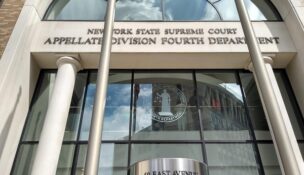
In a split decision, the Appellate Division of state Supreme Court, Fourth Department, has affirmed rape, burglary, and other convictions, despite a jury selection process that did not follow New York State Criminal Procedure Law.
Defendant Terry Everson was convicted before state Supreme Court Justice Gordon J. Cuffy, in Onondaga County, in September 2022, of first-degree rape, second-degree burglary. and fourth degree grand larceny.
The Fourth Department voted 4-1 to uphold the convictions.
The charges stem from two burglaries that occurred three days apart.
In the first burglary, Everson entered a home and stole a purse. In the second burglary, he entered a home and raped a woman.
Everson’s appellate attorney, Piotr Banasiak, argued that Cuffy should not have allowed the prosecutor to exercise a peremptory challenge out of order.
After the selection of 12 jurors, the prosecutor challenged for cause a prospective alternate juror, but Cuffy denied the challenge. The prosecutor declined to use a peremptory challenge but, after Banasiak did not use a peremptory challenge for that prospective alternate juror, the prosecutor stated that they would use one.
Banasiak objected, but Cuffy allowed it.
The majority agreed with the defense argument that Cuffy allowed the prosecutor to exercise a belated peremptory challenge.
Both sides got two peremptory challenges per alternate juror. Under CPL 270.15 (2) the prosecutor “must exercise their peremptory challenges first and may not, after the defendant has exercised (their) peremptory challenges, make such a challenge to any remaining prospective juror who is then in the jury box.”
The majority ruled that Banasiak’s argument was moot because “no alternates participated in the deliberation.”
The majority wrote that the failure to follow the proper procedure “did not in any way affect or impact upon the composition of the defendant’s jury nor … did it affect the selection of those who had previously been empaneled to sit on the jury.”
Banasiak argued that the alleged error may have influenced Everson’s trial lawyer’s decision not to object to keeping jurors on the panel when an issue later surfaced.
“Any objection to the two sworn jurors continuing on the jury based on their passing remarks to a witness outside of the courtroom regarding the length of the court recess would not be likely to succeed inasmuch as the inquiry by the court showed that the jurors did not engage in misconduct of a substantial nature,” the majority wrote.
Banasiak also argued that Cuffy should not have allowed the testimony of a detective who compared Everson’s fingerprints to the ones recovered from the window at the scene of the first burglary, or to grant a mistrial or an adjournment, based on the prosecution’s failure to disclose materials the detective used and generated during the fingerprint analysis.
Cuffy acknowledged that the prosecution failed to comply with Criminal Procedure Law regarding those materials. But the majority ruled that he did not abuse his discretion in fashioning an appropriate sanction.”
Justice E. Jeannette Ogden dissented and voted to reverse the convictions.
“I conclude that Supreme Court abused its discretion in denying defense counsel’s request for an adjournment once it was revealed during trial that the prosecution’s latent fingerprint examiner used documents that had not been turned over to the defense,” Ogden wrote.
“The court’s refusal impacted defense counsel’s ability to effectively cross-examine the latent fingerprint examiner and also impacted defendant’s decision to potentially secure an expert to rebut the latent fingerprint examiner’s analysis,” she wrote.
“Even assuming … that the proof of guilt is overwhelming as to some or all of the counts of which defendant was convicted, I conclude that the error still cannot be considered harmless because there is a reasonable possibility that the error contributed to defendant’s conviction,” she wrote.
“I would therefore reverse the judgment … and grant a new trial on the four counts of which defendant was convicted,” Ogden wrote.
[email protected] / (585) 232-2035
Related Articles
Related Articles
Related Content





Case Digests
- Court of Appeals – Sex Offender Registration Act: People v. Townsend
- Fourth Department – Action for attorney’s fees: Broadway Warehouse Co. v. Buffalo Barn Board LLC
- Second Circuit – Civil forfeiture: United States v. The M/Y Amadea, a Motor Yacht
- Second Circuit – Misdemeanor crime of domestic violence: United States v. Simmons
- Court of Appeals – Sentencing: People v. Flesch
- Court of Appeals – Sex Offender Registration Act: People v. Carnegie; People v. Dockery
- Second Circuit – Products liability: Colwell v. Sig Sauer Inc.
- Second Circuit – Securities Exchange Act: Smith v. The Gap Inc.
- Court of Appeals – Vicarious liability: Mann v. Mezuyon LLC
- Fourth Department – Election Law: Torres v. Zellner
- Second Circuit – Bankruptcy proceedings: Ryniker v. Sumec Textile Co.


Law News
- Hochul calls for investigation of accusations against former judge
- Onondaga County attorney disbarred after federal convictions
- Weapon conviction reversed due to illegal police search
- Attorneys presented with Dillon Awards for child advocacy
- NY appeals court upholds tax exempt status for human service agency
- Convictions reversed over illegal NY State Police search
- President’s message: A view from the 18th tee or the 4th green
- NY judge rejects motion to collect on Iowa court judgment
Polls
 Loading ...