


 Free Newsletter


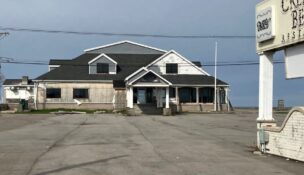
The Crescent Beach Restaurant in Greece. (File photo by Kevin Oklobzija/The Daily Record)
Contractor challenges loan priority in Crescent Beach foreclosure
Kevin Oklobzija//February 9, 2026//


Key takeaways:
- Genesee Construction disputes Casciani Construction’s mortgage priority claim.
- Contractor says lender improperly reclassified a building loan as purchase money.
- Mechanic’s lien seeks nearly $542,000 in unpaid renovation costs.
- Foreclosure stems from stalled Crescent Beach renovation amid Mott legal troubles.
The contractor hired to renovate the long-shuttered Crescent Beach Restaurant for restaurateur Katherine Mott-Formicola contends the project lender has attempted to improperly jump to the front of the foreclosure repayment line.
Genesee Construction Service of Dansville alleges that Casciani Construction Co. — in a December court filing seeking summary judgment — has recharacterized the mortgage on the property from a “building loan mortgage” to a “purchase money mortgage.”
In doing so, Casciani is trying to exert priority over a Genesee Construction mechanic’s lien that seeks just shy of $542,000 in past-due bills should there be any surplus money from a foreclosure sale. So says Genesee Construction president Larry Merle in an affidavit that accompanies his firm’s opposition filing.
“Casciani’s attempt to recharacterize its building loan mortgage transaction after the fact to jump over Genesee in payment priority, notwithstanding the title and contents of its own recorded loan documents, undermines the exact transparency and project funding assurances that a contractor is intended to be protected by in New York,” Merle says in his affidavit.
“Casciani’s effort to change the recorded history of its construction loan after failing to properly comply with the statutory requirements governing construction financing should not be excused.”
That argument was made in papers filed Friday in state Supreme Court in Monroe County by attorney Richard T. Tucker of Harris Beach Murtha Cullina PLLC.
The filings are the latest developments in the Mott saga involving Crescent Beach, her December 2024 conviction on federal charges of financial institution fraud and money laundering, and the ongoing civil check-kiting allegations levied by Five Star Bank in the spring of 2024.
What is not disputed: Casciani Construction provided private financing to a Mott entity, 11 Wexford Glen, LLC, in November 2023 for the purchase and renovation of Crescent Beach, which shut down in 2012. Genesee Construction began work on the property in December of 2023.
But renovation activity came to a halt in the spring of 2024, when Five Star Bank filed a civil lawsuit suit. The bank alleged that Mott’s check-kiting scheme led to a loss of at least $19 million by the financial institution.
Soon after, Genesee Construction filed the mechanic’s lien, contending it had been not paid for $541,851.11 in labor and materials.
In March of 2025, Casciani Construction sought foreclosure on the property. The firm alleged 11 Wexford Glen defaulted on a $1.7 million “building loan mortgage” on Crescent Beach and seven neighboring properties.
But in a December filing seeking summary judgment in the foreclosure case, Casciani Construction is characterizing the loan as a purchase mortgage, according to Tucker, Genesee Construction’s lawyer.
“Plaintiff’s attempt to recharacterize its building loan mortgage transaction after the fact into a purchase money mortgage — notwithstanding the title and contents of its own recorded loan documents — is a transparent attempt to avoid the payment of the mechanic’s lien being given priority upon the sale of the property,” Tucker wrote in his filing.
He points out that the loan documents indicate the money was loaned for the purpose of making “certain improvements to the property,” and that it will be:
• “advanced to pay construction,”
• advanced “not more than once per month upon written application of the borrower (of) approved requisitions for work, labor or services performed” or materials, supplies and equipment.
The filing also says documents provided by Casciani Construction do not include:
• a seller-side closing statement;
• an escrow or title company disbursement ledger;
• any wire confirmation reflecting payment to a seller;
• an affidavit from a closing agent attesting that funds were applied to the purchase price.
For those reasons, Tucker writes, the request for summary judgment must be rejected.
“Each document on its face characterizes the transaction as a building or construction loan, rather than a purchase-money acquisition loan as plaintiff now alleges,” the filing states.
[email protected]/(585) 653-4020
Related Articles
Related Articles
Related Content



Case Digests
- Second Circuit – Long-arm jurisdiction: Northwell Health Inc. v. Group Hospitalization and Medical Services Inc.
- Fourth Department – Motor vehicle accident: Thurston v. Howard
- Western District Case Notes
- Fourth Department – Disclosure: People v. Smith
- Second Circuit – Petition for bail: Fulton v. Mullin
- Fourth Department – Breach of lease agreement: Three Buds, LLC v. NCTBP Calabrese LLC
- Second Circuit – Expert testimony: Rutledge v. Walgreen Co.; Phippen v. Walgreen Co.
- Second Circuit – Congestion pricing: County of Rockland v. Triborough Bridge & Tunnel Auth.
- Fourth Department – Apartment search: People v. Shaw
- Fourth Department – Vicarious liability: Sarah R. v. Crouse Health Hospital
- Fourth Department – Waiver of indictment: People v. Schindler


Law News
- New trial granted for defendant unhappy with their attorney
- NY appellate court reinstates medical malpractice case
- NY appeals court reinstates slip-and-fall lawsuit
- Charter Communications must pay penalty for retaliation against employee
- Webster resident named to lead national court reporter group
- NY appeals court affirms rape conviction, rejects speedy trial claim
- Telesca Center for Justice gets $90,000 in state funding
- Trevett Cristo P.C. celebrates 100th anniversary