


 Free Newsletter

NY appeals court orders suppression hearing in gun case
Bennett Loudon//February 18, 2026//


 Listen to this article
Key takeaways:
- Fourth Department ordered a suppression hearing in a weapon possession case.
- Defendant was convicted of second-degree criminal possession of a weapon.
- Court found defense counsel may have been ineffective for failing to seek suppression of the gun.
- If defendant prevails at the suppression hearing, the indictment will be dismissed.
A state appeals court has sent a homicide case back to a lower court and ordered a suppression hearing.
Defendant Dionedre B. Wyatt was convicted in June 2024 before Monroe County Court Judge Michael L. Dollinger of second-degree criminal possession of a weapon.
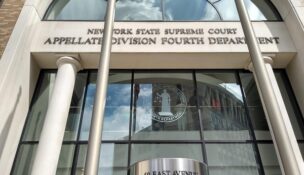
The Appellate Division of state Supreme Court, Fourth Department, ordered the lower court to hold a hearing to determine the legality of police interaction with Wyatt.
Police found a gun in Wyatt’s front pocket at a gas station convenience store after receiving a 911 call reporting that a person matching Wyatt’s description was seen with a cell phone or a gun.
Wyatt’s appellate attorney, Stephanie M. Stare, argued that Wyatt’s conviction is not supported by legally sufficient evidence because the prosecutor failed to establish that the gas station convenience store was not Wyatt’s place of business.
“We reject that contention,” the Fourth Department wrote.
“The evidence at trial established that defendant possessed the weapon outside of the gas station convenience store and … thus, even assuming … that the gas station convenience store was defendant’s place of business, we conclude that the evidence of possession outside of the gas station convenience store is legally sufficient to support the conviction,” the Fourth Department panel wrote.
“We further reject defendant’s contention that his conviction is not supported by legally sufficient evidence because the People failed to prove that he did not have a license for the gun. Defendant, and not the People, had the burden of asserting, as a defense, that he possessed an appropriate firearms license, and defendant did not do so,” the court wrote.
And the court ruled that the verdict is not against the weight of the evidence.
“We agree with defendant, however, that defense counsel was ineffective by failing to move to suppress the gun on the ground that the police encounter was unlawful,” the court wrote.
“Suppression of the gun would have been dispositive of the sole count of the indictment of which defendant was convicted,” the panel found.
“We conclude that the record establishes that defense counsel could have presented a colorable argument that the police officer’s actions were either not justified at the inception of the encounter or otherwise not reasonably related in scope to the circumstances presented,” the court wrote.
The police officer’s encounter with Wyatt was based on a 911 call from a security guard at a nearby restaurant who said that he saw a man who had what looked like a black phone or a gun.
The security guard provided a description of the individual, and told police that, while unsure, he thought the man might have been part of a dispute that had taken place at the restaurant earlier in the day, according to the decision.
At a Huntley hearing, the arresting officer testified, but the testimony and the body camera footage raised a question about the police encounter.
“We further conclude from this record that defense counsel’s failure to seek suppression of the gun was not part of a legitimate pretrial strategy. The record reflects that defense counsel, or at least stand-in counsel, requested a probable cause hearing, but then failed to follow through with that request,” the court ruled.
The judge told Wyatt on two occasions leading up to the Huntley hearing that he would have the chance to challenge the legality of the police encounter.
“There is no discernible reason why that hearing could not have been expanded to afford defense counsel an opportunity to make such a challenge had defense counsel merely requested permission to do so,” the court found.
The court ruled that Wyatt is entitled to a suppression hearing “with respect to the legality of the police encounter.”
The case was sent back to County Court for that hearing.
“In the event that defendant prevails at the suppression hearing, the judgment is reversed and the indictment is dismissed and, if the People prevail, then the judgment should be amended to reflect that result,” the court ruled.
[email protected] / (585) 232-2035
Related Articles
Related Articles
Related Content




Case Digests
- Fourth Department – Ineffective assistance of counsel: People v. Thanthima
- Second Circuit – Sentencing: United States v. Dralle
- Fourth Department – Ineffective assistance of counsel: People v. Serrano
- Second Circuit – Habeas Corpus: Brown v. James
- Fourth Department – Comptroller authority: Scanlon v. Miller-Williams
- Fourth Department – Confidential witness: People v. Sanchez
- Second Circuit – Interest-on-escrow accounts: Cantero v. Bank of America, N.A.; Hymes v. Bank of America, N.A.
- Fourth Department – Relation back doctrine: Poindexter v. The State of New York
- Fourth Department – Double jeopardy: People v. Royal
- Fourth Department – Real property claims — Summary judgment Penn v. Rochester Rev Holdings, LLC
- Second Circuit – Breach of lease agreement: Delsha 60 Ninth, LLC v. Free People of PA LLC


Law News
- Driver who caused fatal MVA sued by victim’s mother
- NY Court of Appeals resolves Appellate Division inconsistency
- Oneida County attorney disbarred after Trump pardon
- New trial ordered in child sex abuse case
- Rochester, Monroe County to pay $1.75M to officer blinded in stabbing
- Drug conviction reversed over faulty indictment
- Phillips Lytle names new Rochester office leader
- WNY nursing home fraud settlement could total $9M
Polls
 Loading ...