


 Free Newsletter

Fourth Department rules ‘law office failure’ does not excuse late filing
Bennett Loudon//May 4, 2026//
Fourth Department rules ‘law office failure’ does not excuse late filing
Bennett Loudon//May 4, 2026//


 Listen to this article
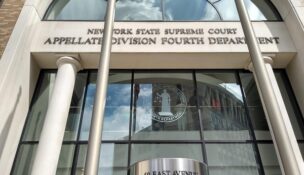
The Fourth Department on Friday issued a split decision reversing a lower court’s ruling that dismissed a lawsuit because the plaintiffs’ attorney missed filing deadlines.
The plaintiffs filed a lawsuit seeking damages for injuries suffered in a motor vehicle accident.
After the defendant moved for summary judgment to dismiss the complaint and all cross-claim, the plaintiffs failed to submit opposition papers on time, or appear for the oral argument.
In September 2024, state Supreme Court Justice Jason L. Cook, in Yates County, granted the defense motion for summary judgment dismissing the complaint and cross-claim.
About two weeks later, the plaintiffs moved to vacate the order pursuant to Civil Practice Rule 5015 (a) (1), but Cook denied the motion in December 2024.
The plaintiff appealed to the Appellate Division of state Supreme Court, Fourth Department, which voted 3-2 to reverse Cook’s ruling and reinstated the complaint.
“We agree with plaintiffs that the court abused its discretion in denying their motion to vacate,” the majority wrote.
On their CPR 5015 (a) (1) motion to vacate the default, the plaintiffs were required to demonstrate a reasonable excuse for the default and a potentially meritorious opposition to the motion, according to the decision.
In making that decision, the judge should consider relevant factors, such as the extent of the delay, prejudice or lack of prejudice to the opposing party, and whether there has been willfulness, according the decision.
Contrary to Cook’s decision, the plaintiffs presented a reasonable excuse of “law office failure,” the majority found.
“There is no evidence of a willful default and the negligible delay cannot be said to have prejudiced defendant,” the court wrote.
“We further conclude that plaintiffs established a meritorious opposition sufficient for the purpose of this motion,” they wrote.
The plaintiffs argued that, even though a driver with the right-of-way is entitled to expect that other drivers will obey the traffic laws requiring them to yield the right-of-way, the driver with the right-of-way still has a duty to use reasonable care to avoid a collision.
“Although there is no dispute that defendant had the right-of-way at the time of the accident, there are issues of fact whether defendant’s speed was reasonable under the circumstances, including defendant’s knowledge that his view of the intersection where the accident occurred was limited by the terrain,” the court wrote.
“Under the circumstances of this case, including the expediently filed motion to vacate, and in light of the public policy favoring the resolution of cases on the merits, we conclude that the court abused its discretion in denying plaintiffs’ motion,” the panel ruled.
Justices E. Jeannette Ogden and Donald A. Greenwood dissented and voted to affirm Cook’s ruling.
“In our view, the court did not err in determining that plaintiffs failed to establish a reasonable excuse for the default,” Ogden and Greenwood wrote.
“While CPR 2005 allows courts to excuse a default due to law office failure, it was not the Legislature’s intent to routinely excuse such defaults, and mere neglect will not be accepted as a reasonable excuse,” the minority wrote.
“A claim of ‘law office failure’ must be supported by a detailed and credible explanation of the default; conclusory and unsubstantiated allegations of ‘law office failure’ are insufficient,” they wrote.
[email protected] / (585) 232-2035
Related Articles
Related Articles
Related Content





Case Digests
- Fourth Department – Option contract: Cass v. Newell
- Fourth Department – Ineffective assistance of counsel: People v. Jaquan C.
- Fourth Department – Medical malpractice: Burns v. Sobieraj
- Fourth Department – Substitution of counsel: People v. Bredt
- Fourth Department – Statute of limitations: Broton v. County of Onondaga
- Fourth Department – Suppression: People v. Ayer
- Fourth Department – Breach of contract: Amber Well Drilling v. Reed , et al.
- Fourth Department – Murder: People v. Baxter
- Fourth Department – Judgment lien: Anthone v. Carlo
- Fourth Department – Video evidence: People v. Alexander
- Court of Appeals- Copyright infringement: Richardson v. Townsquare Media Inc.


Law News
- Fourth Department rules ‘law office failure’ does not excuse late filing
- Judge suppresses evidence in drug case, cites ‘troubling aspect of police behavior’
- NY appeals court rules EMT is not entitled to jury trial on misconduct complaint
- Law Day – Celebrate judicial independence
- NY appeals court reinstates medical malpractice lawsuit
- Lender files foreclosure action on Rochester Airport Marriott
- ERPO issued against former prison guard connected to inmate death
- NY appeals court vacates convictions over illegal frisk
Polls
 Loading ...