


 Free Newsletter

Local attorney suspended for ‘dishonest or deceitful conduct’
Lawyer punished for 'dishonest or deceitful conduct'
Bennett Loudon//February 8, 2022//
Local attorney suspended for ‘dishonest or deceitful conduct’
Lawyer punished for 'dishonest or deceitful conduct'
Bennett Loudon//February 8, 2022//


 Listen to this article
Rochester attorney Gerald W. Dibble has been suspended from practicing law for two years.
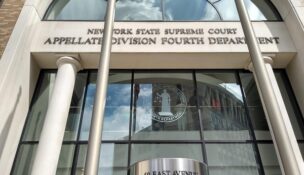
In a decision released Friday, the Appellate Division of state Supreme Court, Fourth Department, found that Dibble’s “misconduct involved an extended course of dishonest or deceitful conduct for personal gain that resulted in substantial harm or prejudice to a client.”
Dibble, the owner of the Dibble & Miller P.C. law firm, received his juris doctor degree from the University of Maryland School of Law in 1971 and was admitted to the bar in June 1972. He also received a master of law degree in taxation at New York University School of Law in 1974.
John Regan Jr., an attorney at Dibble & Miller, said Dibble had no comment.
In October 2019, the Grievance Committee of the Seventh Judicial District filed a petition charging Dibble with professional misconduct.
He was accused of making false statements to a client about the status of their case “and engaging in dishonesty or deceit during the investigation,” according to the Fourth Department’s decision.
The charges stem from Dibble’s representation of a client who was the subject of an Adult Protective Services (APS) investigation that was started after the client was accused of making “numerous disbursements of funds to herself and other family members from accounts owned or controlled by an elderly relative of the client.”
In May 2017, when Dibble took the case, the client paid a $15,000 retainer fee. The retainer agreement said the firm would represent the client for a fee calculated on an hourly basis.
About one week later, Dibble arranged for the client to sign a revised retainer agreement that changed the payment from an hourly rate to a fixed fee of $15,000.
Under the terms of the agreement, the fixed fee would be earned “when there was no entity or agency seeking to charge the client or the client’s brother with financial elder abuse,” according to the decision.
According to the agreement, the representation would not include appeals, hearings, trials or preparation for hearings and trials.
When the client signed the revised retainer agreement, the initial retainer payment of $15,000 had a remaining balance of $10,274.60.
“The revised retainer agreement effectively entitled (Dibble) to keep the entire $15,000 that had been paid by the client, without regard to the amount of hours worked … provided that no entity or agency was seeking to charge the client or the client’s brother with financial elder abuse,” according to the decision.
About three weeks later, Dibble contacted the client to say the APS investigation was “moving along faster than … expected” and he needed another $25,000 to keep the APS investigation from becoming a criminal case, according to the decision.
But Dibble’s description of the status of the APS investigation was false “and made to induce the client to pay the additional funds,” according to the Fourth Department.
The client paid the $25,000 and Dibble arranged for them to sign a second revised retainer agreement, which said the firm was entitled to a “minimum retainer” of $40,000 — the total amount paid.
When Dibble arranged for the client to sign the second revised retainer agreement and to pay the $25,000 he already had documentation from the client and others showing that he knew the transactions that prompted the investigation were authorized by the elderly relative for estate and Medicaid planning purposes and that the client had not committed a crime.
About one week after the client signed the second revised retainer agreement, Dibble asked for another $30,000. About the same time, Dibble “made gestures with his hands to lead the client to believe that she would be in handcuffs and going to prison if the additional funds were not paid,” according to the decision.
But Dibble actually “knew that the client would not be charged with a crime and that his law firm could be entitled to keep the additional $30,000, plus the other funds … without performing additional services on behalf of the client,” the court wrote.
The client gave Dibble a check for $30,000, but a stop payment order was subsequently placed on the check, and the client got another lawyer to represent them.
In March 2018, the initial APS investigation was closed and the matter was transferred to the APS agency in a different county because the elderly relative moved to that county.
The APS agency for the other county decided that no further action would be taken. The client was never contacted by any other investigative agency and no charges were ever brought against the client.
After the client filed a complaint against Dibble in August 2017, Dibble “submitted to the Grievance Committee a written response wherein he made false or deceitful statements regarding material matters,” the court wrote.
Dibble’s written response to the Grievance Committee “also contained self-serving and false or deceitful statements regarding the elderly relative’s mental capacity to authorize the transactions in question.”
“During an examination under oath conducted by counsel to the Grievance Committee in January 2019, (Dibble) made false statements regarding the mental capacity of the elderly relative and falsely testified that the client had told (him) that the client stole the funds belonging to the elderly relative or had taken the funds without the elderly relative’s authorization,” the court wrote.
“Throughout the course of the proceedings before the Grievance Committee and this Court, respondent has made false statements, lacked candor, and given explanations for his conduct that lack credibility.”
“We conclude that respondent should be suspended from the practice of law for a period of two years and until further order of the Court,” the Fourth Department panel wrote.
[email protected] / (585) 232-2035
Related Articles
Related Content





Case Digests
- Fourth Department – Substitution of counsel: People v. Bredt
- Fourth Department – Statute of limitations: Broton v. County of Onondaga
- Fourth Department – Suppression: People v. Ayer
- Fourth Department – Breach of contract: Amber Well Drilling v. Reed , et al.
- Fourth Department – Murder: People v. Baxter
- Fourth Department – Judgment lien: Anthone v. Carlo
- Fourth Department – Video evidence: People v. Alexander
- Court of Appeals- Copyright infringement: Richardson v. Townsquare Media Inc.
- Fourth Department – Marital property: Zatyko v. Zatyko
- Second Circuit – Supervised release: United States v. Brown
- Fourth Department – Exculpatory evidence: People v. Williams


Law News
- Judge suppresses evidence in drug case, cites ‘troubling aspect of police behavior’
- NY appeals court rules EMT is not entitled to jury trial on misconduct complaint
- Law Day – Celebrate judicial independence
- NY appeals court reinstates medical malpractice lawsuit
- Lender files foreclosure action on Rochester Airport Marriott
- ERPO issued against former prison guard connected to inmate death
- NY appeals court vacates convictions over illegal frisk
- The Goldberg Segalla law firm celebrates 25th anniversary
Polls
 Loading ...