


 Free Newsletter

Assault conviction overturned: ‘The verdict is against the weight of the evidence’
Bennett Loudon//May 6, 2022//
Assault conviction overturned: ‘The verdict is against the weight of the evidence’
Bennett Loudon//May 6, 2022//


 Listen to this article
A state appeals court has reversed an assault conviction and dismissed the indictment,
Defendant Justin T. Palombi was convicted in September 2019 in Ontario County before state Supreme Court Justice Christopher S. Ciaccio, of third-degree assault.
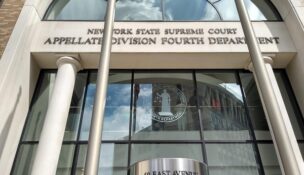
In a decision released April 29, the Appellate Division of state Supreme Court, Fourth Department, unanimously reversed the conviction.
The charge stems from an incident where Palombi was driving a motor vehicle and a passenger was injured in an accident allegedly caused by Palombi’s criminal negligence.
On a curve in the road, Palombi’s car crossed over the double yellow line into the oncoming lane and forced an oncoming vehicle to pull over to avoid a collision, according to the decision.
Palombi steered back into his lane, but he lost control of the car and it went off the road and crashed into a mailbox, a tree and a utility pole.
At the time of the accident, Palombi had a learner’s permit, but no driver’s license.
Palombi’s appellate lawyer, Cara A. Waldman, argued that the conviction is not supported by legally sufficient evidence and that the verdict is against the weight of the evidence.
The Fourth Department rejected that contention with respect to the sufficiency.
“Viewing the evidence in the light most favorable to the prosecution, we conclude that it is legally sufficient to support the conviction,” the panel wrote.
But the court agreed that “viewing the evidence in light of the elements of the crime as charged to the jury, the verdict is against the weight of the evidence,” according to the decision.
The Fourth Department reviewed the “weight of the evidence” to determine whether an acquittal would have been unreasonable.
The court serves “as a second jury with the power to independently assess all of the proof,” according to the decision.
“Here, we conclude that acquittal would not have been unreasonable and the jury was not justified in finding beyond a reasonable doubt that defendant was criminally negligent in his operation of the vehicle,” the panel wrote.
Criminal negligence cases in automobile accidents involving excess rates of speed, require the defendant to take “some additional affirmative act” to transform ‘speeding’ into “dangerous speeding,” the court wrote.
The prosecution expert’s testimony that Palombi was driving about 92 miles per hour at the time of the incident was speculative, the panel wrote.
The expert’s calculation of the vehicle’s speed was based on the assumption of “100 percent braking,” but there was no evidence that (Palombi) braked at all before his vehicle collided with the mailbox, tree and utility pole, according to the decision.
“The prosecutor’s version of the events, that defendant deliberately attempted to ‘flatten out the curve’ by crossing the double line of the curve, does not rise to the level of moral blameworthiness to constitute criminal negligence,” the Fourth Department ruled. “Contrary to the People’s assertion, the fact that defendant knowingly drove with a passenger in violation of the restrictions placed upon his learner’s permit does not establish beyond a reasonable doubt that defendant engaged in some blameworthy conduct that either created or contributed to a substantial and unjustifiable risk.”
[email protected] / (585) 232-2035
Related Articles
Related Content





Case Digests
- Court of Appeals – Implied covenant of good faith: 111 West 57th Investment, et al. v. 111 W57 Mezz Investor, et al.
- Fourth Department – Negligence: Castle v. Swarfiguer
- Fourth Department – Bifurcation: Calvaneso v. Mochol
- Court of Appeals – Sex Offender Registration Act: People v. Townsend
- Fourth Department – Action for attorney’s fees: Broadway Warehouse Co. v. Buffalo Barn Board LLC
- Second Circuit – Civil forfeiture: United States v. The M/Y Amadea, a Motor Yacht
- Second Circuit – Misdemeanor crime of domestic violence: United States v. Simmons
- Court of Appeals – Sentencing: People v. Flesch
- Court of Appeals – Sex Offender Registration Act: People v. Carnegie; People v. Dockery
- Second Circuit – Products liability: Colwell v. Sig Sauer Inc.
- Second Circuit – Securities Exchange Act: Smith v. The Gap Inc.


Law News
- Hochul calls for investigation of accusations against former judge
- Onondaga County attorney disbarred after federal convictions
- Weapon conviction reversed due to illegal police search
- Attorneys presented with Dillon Awards for child advocacy
- NY appeals court upholds tax exempt status for human service agency
- Convictions reversed over illegal NY State Police search
- President’s message: A view from the 18th tee or the 4th green
- NY judge rejects motion to collect on Iowa court judgment
Polls
 Loading ...