


 Free Newsletter

Appeals court dismisses lawsuit against town of Amherst
Fourth Department votes 4-1
Bennett Loudon//June 29, 2023//


In a split decision, a state appeals court has affirmed a decision to grant a motion to dismiss a lawsuit against the town of Amherst.
Plaintiff Lee Fang sued the town of Amherst and the town’s highway department. Fang claimed his concrete driveway was damaged by town workers when the street in front of his house was repaved.
In February 2022, in state Supreme Court Justice in Erie County, Justice Catherine R. Nugent Panepinto granted a defense motion for summary judgment, dismissing the complaint.
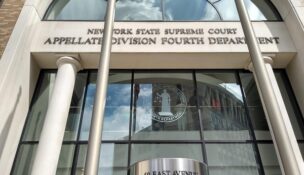
Fang appealed and the Appellate Division of state Supreme Court, Fourth Department, affirmed the lower court ruling on the ground that Fang failed to comply with the defendants’ demand for an oral examination, as required under General Municipal Law.
When a notice of claim is filed against a town, the town has the right to demand an examination of the claimant “relative to the occurrence and extent of the injuries or damages for which claim is made,” according to the Fourth Department’s decision.
The demand must be in writing and served personally or by registered or certified mail on the claimant unless the claimant is represented by an attorney. In that case, the demand must be served personally or by mail on the attorney.
“Contrary to plaintiff’s contention, Supreme Court properly granted defendants’ cross-motion inasmuch as defendants met their initial burden of establishing that defendant town of Amherst timely served plaintiff with a demand for examination by certified mail as required under General Municipal Law,” according to the decision.
Fang did not dispute that he timely received actual notice of the town’s demand for an examination or that the requested examination was adjourned several times at plaintiff’s request.
“In his last correspondence with the town prior to filing suit, plaintiff did not request another adjournment, but instead refused to participate in any hearing, arguing incorrectly that the town had waived its right to such because it failed to timely serve the notice,” the court wrote.
The motion for summary judgment was granted only after the defendants’ attorney conceded that Fang’s refiling “would not be precluded by the statute of limitations and that accommodations would be offered to hold the hearing in a manner that addressed plaintiff’s pandemic-related concerns,” according to the decision.
Associate Justice E. Jeannette Ogden dissented and voted to modify the lower court ruling.
“In my view, plaintiff’s evidence submitted in opposition to defendants’ cross-motion for summary judgment dismissing the amended complaint raised a question of fact whether exceptional circumstances existed excusing his failure to attend an examination,” she wrote.
“While I understand the conclusion the majority reached, I do not agree. It does not appear on this record that plaintiff was trying to avoid the examination itself,” she wrote.
“According to plaintiff’s evidence, he offered alternatives to an in-person examination … given his concerns regarding the ongoing COVID-19 pandemic, including an inspection of his property and a stipulation of facts surrounding the claim,” she wrote.
Fang claimed he was unable to adjourn the examination because the town repeatedly told him no further adjournments would be granted and, although he suggested alternatives to an in-person examination, the town extended no other option despite the risks arising out of the ongoing pandemic, according to the decision.
“Inasmuch as there was no fraud or deliberate misleading on the part of plaintiff . . . in order to avoid a General Municipal Law hearing, and there were health risks associated with an in-person appearance during the COVID-19 pandemic, I would conclude that plaintiff’s evidence raised a triable issue of fact whether his noncompliance is excusable,” Ogden wrote.
[email protected] / (585) 232-2035
Related Articles
Related Content



Case Digests
- Second Circuit – Long-arm jurisdiction: Northwell Health Inc. v. Group Hospitalization and Medical Services Inc.
- Fourth Department – Motor vehicle accident: Thurston v. Howard
- Western District Case Notes
- Fourth Department – Disclosure: People v. Smith
- Second Circuit – Petition for bail: Fulton v. Mullin
- Fourth Department – Breach of lease agreement: Three Buds, LLC v. NCTBP Calabrese LLC
- Second Circuit – Expert testimony: Rutledge v. Walgreen Co.; Phippen v. Walgreen Co.
- Second Circuit – Congestion pricing: County of Rockland v. Triborough Bridge & Tunnel Auth.
- Fourth Department – Apartment search: People v. Shaw
- Fourth Department – Vicarious liability: Sarah R. v. Crouse Health Hospital
- Fourth Department – Waiver of indictment: People v. Schindler


Law News
- New trial granted for defendant unhappy with their attorney
- NY appellate court reinstates medical malpractice case
- NY appeals court reinstates slip-and-fall lawsuit
- Charter Communications must pay penalty for retaliation against employee
- Webster resident named to lead national court reporter group
- NY appeals court affirms rape conviction, rejects speedy trial claim
- Telesca Center for Justice gets $90,000 in state funding
- Trevett Cristo P.C. celebrates 100th anniversary