


 Free Newsletter

NY appeals court cuts sentence in Monroe County homicide case
Bennett Loudon//October 10, 2025//


 Listen to this article
- Appeals court reduces homicide sentence from 25 to 5 years
- Defendant’s abuse history cited as grounds for leniency
- Court invokes “interest of justice” power despite appeal waiver
- Decision split 3–2, with dissent opposing reduced authority scope
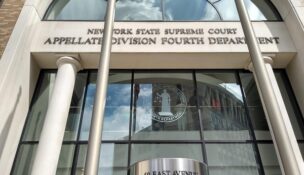
In a split decision, a state appeals court has reduced the prison sentence in a homicide case from 25 years to five years.
The defendant, identified as Hannah T., pleaded guilty in April 2023 before Monroe County Court Judge Stacey Romeo to first-degree manslaughter.
The crime involved the then 17-year-old defendant and her then 16-year-old codefendant boyfriend who fatally shot Hannah’s mother.
Hannah appealed to the Appellate Division of state Supreme Court, Fourth Department, seeking youthful offender status, but Hannah’s plea agreement included a waiver of her right to appeal.
The waiver prevented the Fourth Department from addressing Romeo’s denial of youthful offender status.
But a plea agreement “cannot extinguish our power to independently review a sentence in the interest of justice,” the majority wrote.
“Where a sentence is fundamentally unjust and all other safeguards have failed, we are compelled to exercise our constitutionalized interest of justice power to correct the injustice, no matter the validity of the appeal waiver,” the court wrote.
According to a report from a social worker, Hannah suffered neglect and sexual abuse by her biological family. Later, she suffered extreme abuse and torture at the hands of adoptive parents in Arizona from the age of six to 11.
She was physically and psychologically abused, including “being starved to the point of malnourishment, forced to live outside, often while naked, and made to perform extreme physical exercise as punishment for allegedly stealing from her adoptive parents,” according to the report.
When she was removed from her adoptive home, Hannah weighed about 60 pounds. The adoptive parents were arrested and charged with child abuse. The adoptive father was sentenced to 14 in prison and the adoptive mother was sentenced to 20 years.
Before the adoptive parents’ sentencing, Hannah submitted a victim statement describing her treatment. She wrote that her adoptive parents put duct tape over her mouth for days at a time, and she was forced to run outside for hours. And they dressed her like a baby, including wearing diapers when she was inside the home.
When she was 16, after two more failed foster placements, and a stay at a residential facility, Hannah went to live with her biological maternal grandmother.
But the grandmother left Hannah alone with her mother in New York state where she was physically and psychologically abused. And her mother refused to take defendant to a hospital when she was miscarrying a pregnancy.
The report also stated that Hannah’s cognitive development was significantly impaired by the abuse that she suffered between the ages of six and 11.
“Defendant was susceptible to outside influence and unlikely to have understood the consequences of her actions,” according to the report.
Hannah’s mother asked Romeo for leniency in sentencing, stating that Hannah “already did her time and got enough punishment from life.”
An officer involved in Hannah’s arrest, stated that she may have been manipulated by her boyfriend, according to the decision.
“We have before us strong evidence that defendant has undergone extreme and heinous abuse, which would have entitled her to consideration for sentencing pursuant to the Domestic Violence Survivors Justice Act,” the majority wrote.
“Under the unique circumstances of this case, including the heinous childhood abuse of defendant and the trauma she suffered as a result, the plea for leniency from the victim’s mother, and defendant’s lack of personal involvement in the violent act, we conclude that a prison sentence of 25 years is unjust and oppressive in relation to this crime and this defendant, and it must be corrected,” the majority wrote.
The court voted 3-2 to reduce the sentence to five years in prison, followed by five years of post-release supervision.
Justices John M. Curran and Nancy E. Smith dissented and voted to affirm the original sentence.
“In our view, the majority advances an expansive theory of the Appellate Division’s authority that is incompatible with both Court of Appeals case law elucidating the scope of that authority and this Court’s long-held understanding of its power,” Curran and Smith wrote.
“We submit that this Court’s role is to neutrally apply its power of appellate review — both its discretion and its constraints — in unsympathetic and sympathetic cases alike,” the dissenters wrote.
[email protected] / (585) 232-2035
Related Articles
Related Articles
Related Content




Case Digests
- Fourth Department – Ineffective assistance of counsel: People v. Thanthima
- Second Circuit – Sentencing: United States v. Dralle
- Fourth Department – Ineffective assistance of counsel: People v. Serrano
- Second Circuit – Habeas Corpus: Brown v. James
- Fourth Department – Comptroller authority: Scanlon v. Miller-Williams
- Fourth Department – Confidential witness: People v. Sanchez
- Second Circuit – Interest-on-escrow accounts: Cantero v. Bank of America, N.A.; Hymes v. Bank of America, N.A.
- Fourth Department – Relation back doctrine: Poindexter v. The State of New York
- Fourth Department – Double jeopardy: People v. Royal
- Fourth Department – Real property claims — Summary judgment Penn v. Rochester Rev Holdings, LLC
- Second Circuit – Breach of lease agreement: Delsha 60 Ninth, LLC v. Free People of PA LLC


Law News
- NY Court of Appeals resolves Appellate Division inconsistency
- Oneida County attorney disbarred after Trump pardon
- New trial ordered in child sex abuse case
- Rochester, Monroe County to pay $1.75M to officer blinded in stabbing
- Drug conviction reversed over faulty indictment
- Phillips Lytle names new Rochester office leader
- WNY nursing home fraud settlement could total $9M
- Elmira settles federal lawsuit over police encounter for $2.5M
Polls
 Loading ...