


 Free Newsletter

New trial ordered in drug case after jury selection flub
Bennett Loudon//April 1, 2026//


 Listen to this article
A state appeals court has ordered a new trial in a drug case because of an error during jury selection.
Defendant Dennis Jones was convicted in June 2024 before Onondaga County Court Judge Theodore H. Limpert of third- and fourth-degree criminal possession of a controlled substance.
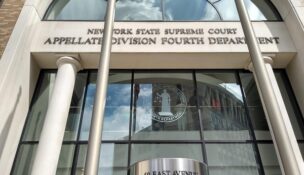
The Appellate Division of state Supreme Court, Fourth Department, unanimously reversed the convictions, and granted a new trial.
Jones was tried with a codefendant, and his appellate attorney, Casey S. Duffy, argued that Limpert should not have permitted the codefendant to unilaterally exercise peremptory challenges.
“We agree,” the Fourth Department wrote.
“The court’s process of allowing defendant and codefendant to each unilaterally exercise their shared peremptory challenges was in violation of (New York Criminal Procedure Law) and resulted in defendant and codefendant exhausting their shared peremptory challenges before all jurors were selected,” the court wrote.
The mistaken denial of a defendant’s peremptory challenge mandates automatic reversal, the court wrote.
The court also agreed with the defense contention that reversal is required on the additional ground that the court erred in denying a request to subpoena records related to the fingerprint examiner, the court wrote.
To obtain a third-party subpoena, a defendant must provide a factual basis for a court to draw an inference that specific materials are reasonably likely to contain information that has the potential to be both relevant and exculpatory, according to the Fourth Department ruling.
“The subpoena request should have been granted because the additional materials sought by defendant related to the examiner’s previous errors and bore on the reliability of her identification of defendant’s fingerprints in this case,” the panel wrote.
“That error is not harmless because the proof of guilt is not overwhelming,” the panel wrote.
The Fourth Department also ruled that Limpert did not abuse his discretion by denying a defense motion to sever Jones’ trial from the codefendant.
“The defenses of defendant and codefendant were not in irreconcilable conflict, nor was there a significant danger that any alleged conflict led the jury to infer either defendant’s guilt,” the court wrote.
The court also ruled that Limpert “properly refused to suppress the physical evidence.”
“To the extent that defendant preserved for our review his contention that the conviction is not supported by legally sufficient evidence of possession, we conclude that it lacks merit,” the court wrote.
“Viewing the evidence in light of the elements of the crimes as charged to the jury, we conclude that, although a different verdict would not have been unreasonable, it cannot be said that the jury failed to give the evidence the weight it should be accorded.”
[email protected] / (585) 232-2035
Related Articles
Related Articles
Related Content





Case Digests
- Fourth Department – Option contract: Cass v. Newell
- Fourth Department – Ineffective assistance of counsel: People v. Jaquan C.
- Fourth Department – Medical malpractice: Burns v. Sobieraj
- Fourth Department – Substitution of counsel: People v. Bredt
- Fourth Department – Statute of limitations: Broton v. County of Onondaga
- Fourth Department – Suppression: People v. Ayer
- Fourth Department – Breach of contract: Amber Well Drilling v. Reed , et al.
- Fourth Department – Murder: People v. Baxter
- Fourth Department – Judgment lien: Anthone v. Carlo
- Fourth Department – Video evidence: People v. Alexander
- Court of Appeals- Copyright infringement: Richardson v. Townsquare Media Inc.


Law News
- Fourth Department rules ‘law office failure’ does not excuse late filing
- Judge suppresses evidence in drug case, cites ‘troubling aspect of police behavior’
- NY appeals court rules EMT is not entitled to jury trial on misconduct complaint
- Law Day – Celebrate judicial independence
- NY appeals court reinstates medical malpractice lawsuit
- Lender files foreclosure action on Rochester Airport Marriott
- ERPO issued against former prison guard connected to inmate death
- NY appeals court vacates convictions over illegal frisk
Polls
 Loading ...