


 Free Newsletter

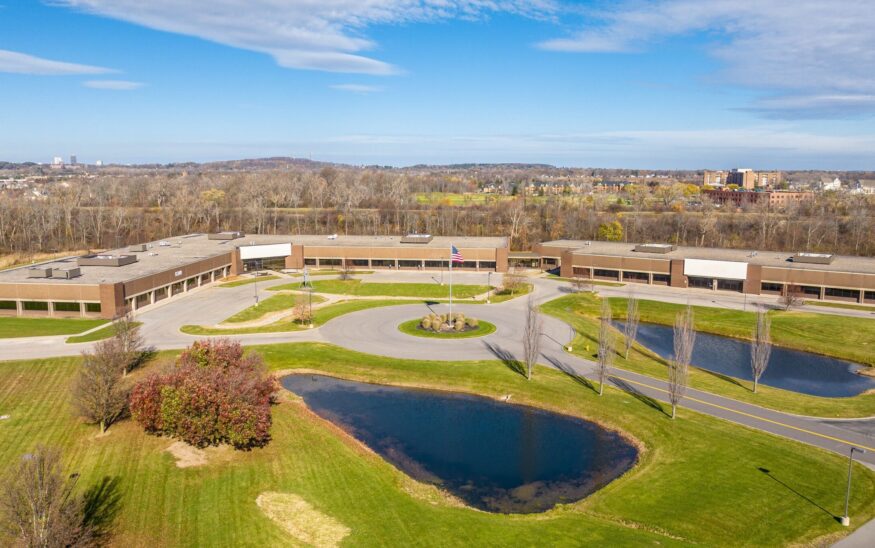
Canal View Office Park in Brighton. (Photo provided by RYCO Management)
Suburban office market rebounds as Class B space gains demand
Kevin Oklobzija//January 28, 2026//


Key takeaways:
- Suburban office vacancy rates have improved, especially for Class B properties.
- Brighton, Bushnell’s Basin and Pittsford are among the most active submarkets.
- Downtown office vacancy remains elevated as tenants favor suburban locations.
- Employers are upgrading office space to compete with remote work options.
Peter Gillett has been working as a commercial real estate broker in Rochester for nearly 20 years, and at no point during that span has the industry ever been all that bullish on the local office sector.

“Office space has always seemed to be shrinking,” he said. “My whole career, I’ve felt people have been a little pessimistic with office space.”
And yet, as Gillett points out, leases continue to be signed and existing spaces are being remodeled and upgraded for new tenants as the suburban submarkets continue to stabilize in the wake of COVID-19.
While the office square footage in downtown Rochester has seen contraction as developers turn cubicles and board rooms into apartments, suburban space has been popular, including, perhaps surprisingly, the Class B subset.
“There’s still demand, there are pockets in Rochester — Brighton, Bushnell’s Basin, Pittsford — where people want to be,” said Gillett, associate broker at Flaum Management Co. and president of the Rochester Chapter of the New York State Commercial Association of Realtors.
Cushman & Wakefield‘s Marketbeat report for the fourth quarter of 2025, compiled by director of marketing and research Daniel Hefner, provides proof. Overall vacancy in the suburban southeast submarket is 17 percent, and just 15 percent for Class B space. In the suburban central submarket, overall office vacancy is 16.3 percent, and just 11.4 for Class B.
“It’s totally encouraging,” said Martin Manila, salesperson at Pyramid Brokerage/Cushman & Wakefield Rochester office. “For the past six or seven years, it’s really been about challenges in the office sector but this is obviously momentum we want to capitalize on.

“Companies can predict a bit better what their needs are going to be. And in Rochester, health care, education, financial services, the legal sector, they’re all staples to our community and they aren’t going anywhere.”
Downtown was less encouraging, especially for Class B assets. The overall vacancy rate was 29 percent (24.4 for Class A, 33 for Class B). Tenants have prioritized convenience for employees and tenants, which mean relocating to suburban locales. Few office buildings downtown have the luxury of parking.
“Rochester is a city where you want to drive less than 15 minutes to work, pull up and walk into your building,” Gillett said. “The real estate assets that have that have an advantage, that’s a real thing.”
One of those higher-end suburban Class B properties, Canal View Office Park in Brighton, is a prime example of increasing tenancy. Of the 225,000 square feet of leasable space, only 25,000 is vacant, and that could be filled soon if potential tenant accepts a proposal to move in.
Trevett Cristo PC, which was headquartered downtown for nearly 100 years, relocated to Canal View in December of 2023. Panasonic left First Federal Place near Four Corners in downtown a year ago for the Brighton office park.
“People like a park-like atmosphere in the suburbs, one story, 24-hour access,” Gillett said. “I think those check a lot of boxes for people.”
Indeed, the office itself must be more than just functional to avoid a push-back from employees who became accustomed to working remotely during the COVID-19 pandemic.
“Maybe over the years people were, ‘Hey, I just need cheaper office space. We’re going to try to maximize the amount of employees in the space and just make it work,’ ” Gillett said. “Now post-COVID, I always joke, you have to beat your spare bedroom. Because if you’re going to give someone an environment that’s not as good as their spare bedroom or their home office, then they’re going to push to work from home.”
For some employment sectors, such as therapists, wealth managers, estate planners and attorneys, physical location as an integral piece of the operations puzzle.
“Customers really like that interaction,” said Kurt Voss, vice president at RYCO Management, which has leasing space within its office portfolio for more than 50 years.
Employers also are placing a greater emphasis on maintaining culture. They want employees back in the office, Voss said. “That collaboration is huge from a professional development standpoint.”
The bump in Q4 suburban office leasing perhaps was predictable, since activity in Rochester often eventually mirrors what’s happening elsewhere. At a recent Society of Industrial & Office Realtors (SIOR) in Louisville, it was noted that Class A office remains stable and is performing well, Gillett said.
“The square footage might be trending down a little bit,” he said, “but to get people excited to come back to the office, owners are sprucing things up; we’re going to put in some glass walls, we’re going to put in some higher features.’ ”
Manhattan saw Q4 leasing of office space rise 8 percent quarter over quarter and 22 percent for 2025, according to Cushman & Wakefield data.
“That was their strongest leasing quarter since 2019,” Manila said. “I think that’s a great indicator of what’s to come and what is happening in Rochester now.”
While Class B space has fit the need for many tenants, the post-COVID flight to quality trend remains very real. Or, in the case of Nixon Peabody, a flight from quality to quality. The legacy law firm departed one of downtown’s prime Class A buildings, Clinton Square, for High Point in Victor, which Gillett said is “arguably the most Class A space in town.”
The firm significantly downsized the square footage footprint, from around 100,000 at Clinton Square to 50,000 at High Point, but made sure the office made a statement.
“Our new office focuses on the future and exemplifies form following function,” Jared C. Lusk, managing partner of the Rochester office, said when Nixon Peabody christened the new space. “While aesthetically beautiful, we first ensured the space would meet the needs of our people, enabling us to provide exceptional client service, both now and well into the future.”
Not everyone wants to lease, however. Owner occupancy of office buildings continues to make business sense for many.
“In Rochester, if I’m an investor and I only can get $15 a square foot and my expenses are $5 a square foot and I have a mortgage to pay, there’s not much meat left on the bone as an investor,” Gillett said. “If you own the building, then there’s meat on the bone.”
That’s especially true since the appreciation on the rents in this market traditionally don’t keep up with inflation.
So for tenants looking to upgrade a space or move into a new building, they sometimes must decide: is purchasing a property is a better option than what it’s going to cost for a build-out cost — at around $100 or more per square foot — and new lease.
“The user-occupants have said, ‘I can remodel my office and pay X-amount, but in order for it to make sense (for the building owner), the landlord is requiring me to sign a 10-year lease,” Gillett explained. “Am I better off getting a 20-year mortgage and buying a building? Some stable clients like a law firm or a health practitioner can justify doing that, because they know they’re going to be around for a while.”
What’s definitely not trending upward, especially nationally: Class C office space. It’s either being converted, very likely into multifamily; it’s being gutted and revamped into Class A or B space, or it’s being demolished.
“It’s probably not being knocked down in Rochester,” Gillett said, “but if you have a Class C product downtown, that product’s just not attractive to a lot of businesses anymore to get people excited to come into the office.”
[email protected]/(585) 653-4020
Related Articles
Related Articles
Related Content






Case Digests
- Fourth Department – Burglary plea: People v. Small
- Court of Appeals – Ineffective assistance of counsel: People v. Fernandez
- Fourth Department – Youthful offender status: People v. Speed
- Fourth Department – Child neglect: Matter of De’Lawrence S. III
- Court of Appeals – Missing witness instruction: People v. Khiamdavanh
- Second Circuit – Securities fraud: Huey v. Anavex Life Sciences Corp.
- Fourth Department – Probation conditions violations: People v. Relyea
- Fourth Department – Ineffective assistance of counsel: People v. Remington
- Court of Appeals – Substitution of counsel: People v. Kelley
- Fourth Department – Due process: People v. Pulley
- Court of Appeals – Equitable estoppel: Incorporated Village of Freeport v. Freeport Plaza West LLC


Law News
- Lawsuit dismissed in Rochester police chase car crash
- NY appeals court reinstates criminal charges
- Cybersecurity requires strategy, culture and vigilance, local experts advise
- Gun conviction reversed over illegal search
- NY appeals court grants new trial for defendant who attacked RPD officer
- NY appeals court reinstates attempted murder charge
- Harris Beach Murtha adds Boston firm Peabody & Arnold
- Attorney and law firm sanctioned for AI mistakes in court filing
Polls
 Loading ...